
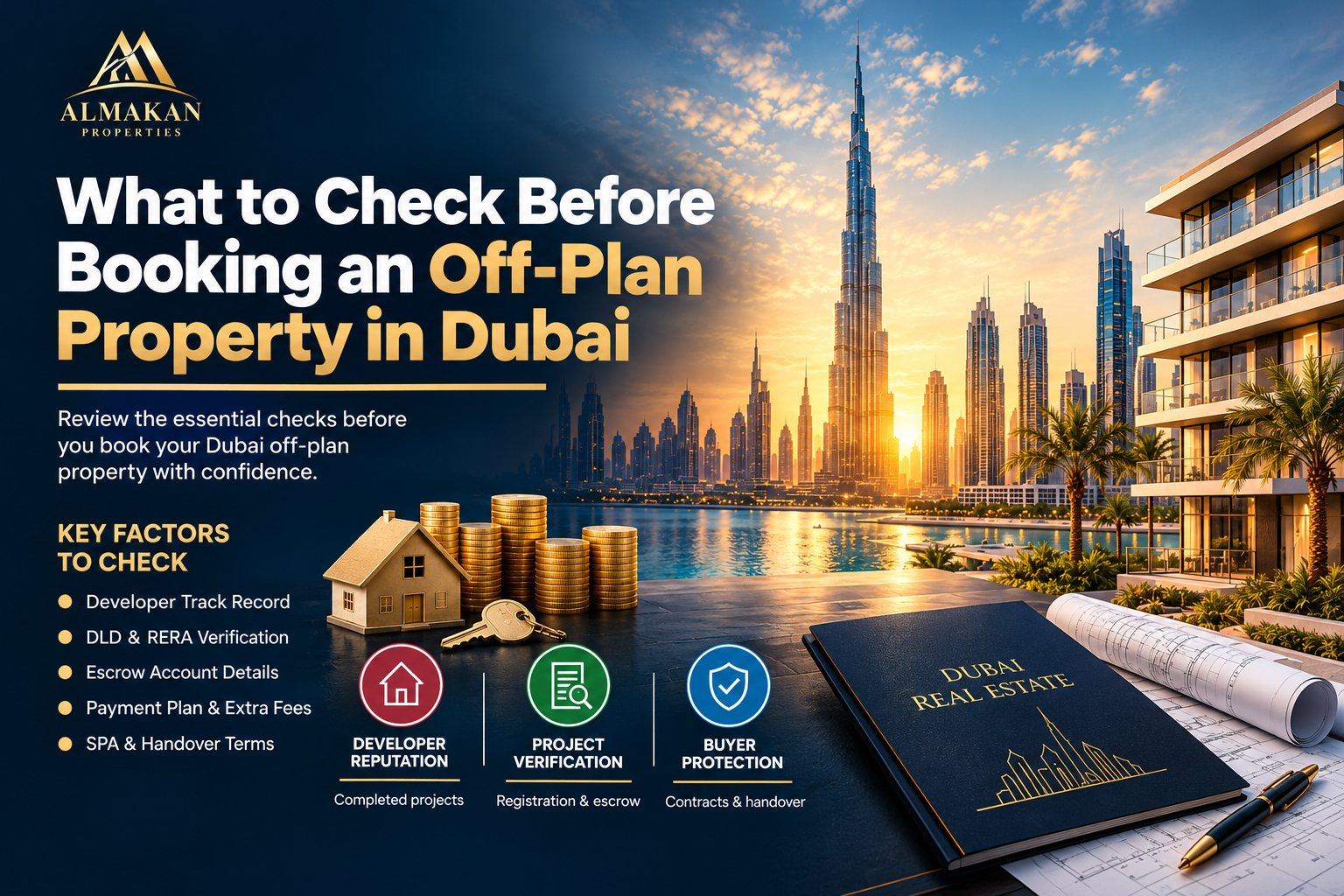
Buying an off-plan property in Dubai can be an attractive option for homebuyers and real estate investors looking for modern developments, flexible payment plans, and long-term investment opportunities. However, purchasing a property before construction is completed requires careful research and financial planning.
Before paying a booking amount, you should verify the developer, confirm the project’s registration, understand the payment structure, and review the legal documents. These checks can help you identify potential risks and make a more informed property investment decision.
In this guide, we explain what to check before booking an off-plan property in Dubai, including the essential legal, financial, and practical considerations every buyer should understand.
1. Verify the Property Developer’s Reputation
The first step when buying an off-plan property in Dubai is to research the developer’s track record. A well-known brand can be a useful starting point, but you should evaluate the specific developer and project independently.
Check the developer’s completed projects, construction quality, delivery history, and feedback from existing property owners. If possible, visit a completed development to assess the building, facilities, and maintenance standards.
Before making a decision, consider:
- Previous project completion and handover records.
- Construction quality and property specifications.
- Buyer reviews and after-sales support.
- Transparency regarding payment plans and contractual terms.
- The developer’s registration and project approvals.
A strong track record may provide useful evidence of experience, but it does not guarantee that every new development will be completed on schedule or deliver a particular investment return.
2. Check Project Registration with Dubai Land Department
One of the most important steps before booking an off-plan property is verifying that the specific development is registered with the relevant Dubai authorities.
The Dubai Land Department (DLD) and the Real Estate Regulatory Agency (RERA) oversee important aspects of Dubai’s property market. Buyers should verify the developer’s registration, the project’s official status, and the relevant approvals before committing funds.
Use the Dubai Land Department official website or the Dubai REST app to access available project verification services.
Check the following details:
- Official project name and registration information.
- Developer’s legal name.
- Project status and available construction progress information.
- Expected completion date, where recorded.
- Whether the unit and project details match the booking documents.
Do not rely exclusively on brochures, advertisements, or verbal assurances from sales representatives. If the official information differs from the documents you receive, request written clarification before proceeding.
3. Confirm the Project Escrow Account
An escrow account is a key consideration when purchasing off-plan real estate in Dubai. Under Dubai’s applicable regulatory framework, qualifying off-plan developments operate through designated project escrow arrangements.
These accounts are intended to manage buyer payments for the relevant development under the applicable rules.
Before transferring your booking amount or instalment, confirm:
- The project’s official escrow account details.
- The name of the bank or approved escrow account trustee.
- Whether the payment instructions match the registered project.
- That the account details are consistent with the official information available.
- That you receive an official payment receipt.
Never transfer money to an unrelated personal account simply because an agent requests it.
You can review the DLD’s official project registration service for information about project registration and escrow arrangements.
Important: An escrow account is a regulatory safeguard, not a guarantee of timely completion, a full refund, or investment profitability.
4. Understand the Payment Plan and Booking Amount
Dubai property developers may offer different payment plans depending on the project, construction stage, and unit type.
Common structures include construction-linked instalments and post-handover payment plans. While these options can help buyers organise their finances, the advertised booking amount does not represent the full cost of purchasing the property.
Before booking, confirm:
- The initial booking amount and deposit.
- The percentage payable at each stage.
- The dates and conditions for future instalments.
- The amount due at completion or handover.
- Any late-payment penalties or default provisions.
- Whether the payment plan is documented in the contract.
- Calculate your future financial commitments and ensure you can meet instalments without relying on uncertain income or anticipated property appreciation.
A manageable payment plan is more important than an attractive promotional offer that stretches your budget.
5. Calculate All Additional Property Purchase Costs
When investing in Dubai real estate, buyers should budget for more than the advertised property price.
Depending on the transaction and property, additional costs may include Dubai Land Department registration fees, registration-related service charges, trustee or administrative fees, mortgage expenses, and other applicable charges.
You should also consider recurring costs such as service charges, property management, insurance where applicable, utilities, and maintenance.
Before signing, request a written breakdown of the expected costs and identify which charges are payable by the buyer.
For rental property investments, estimate potential income after allowing for vacancy periods, operating expenses, and applicable management fees.
Understanding the total cost of ownership helps you compare different off-plan properties more accurately and assess whether the investment fits your financial goals.
6. Review the Sales and Purchase Agreement (SPA)
The sales and purchase agreement (SPA) sets out important terms governing your property purchase. Read it carefully before signing, and seek independent legal advice if any clause is unclear.
Pay particular attention to:
- The developer’s legal entity and your buyer details.
- The unit number, floor plan, size, and agreed specifications.
- The purchase price and instalment schedule.
- The expected completion and handover provisions.
- Conditions relating to delays and changes to the project.
- Cancellation, default, and refund terms.
- Dispute resolution provisions and applicable remedies.
Confirm that the SPA matches the property and payment plan you were offered.
Do not assume that verbal promises about discounts, guaranteed rental income, views, or handover dates are binding unless they are properly documented in the relevant contractual terms.
7. Check the Construction Timeline and Expected Handover
Construction progress is particularly important when buying an off-plan apartment, villa, or townhouse.
Ask the developer for the expected completion date and review the construction status using available official information. Compare this with the timeline stated in the sales documents.
You should also understand what happens if construction is delayed and which contractual provisions apply.
If you intend to rent out the property, consider how a delay could affect your expected rental income, mortgage payments, and other financial commitments.
Avoid making investment calculations based solely on an advertised handover date. Construction schedules can change, and future completion should not be treated as guaranteed.
8. Evaluate the Location and Future Demand
The location of an off-plan property can influence its appeal to future residents, tenants, and buyers.
Research the surrounding area, including road connectivity, public transport, schools, healthcare facilities, shopping destinations, employment centres, and planned infrastructure.
In Dubai, compare developments across suitable communities rather than choosing a property based only on its launch price or marketing campaign.
For investment purposes, examine comparable property prices, rental demand, expected service charges, competing developments, and potential resale liquidity.
Consider whether the property suits your objective: personal use, long-term rental income, or resale after completion.
No location or development guarantees capital appreciation. A realistic assessment should account for market conditions, ongoing costs, and the possibility that future demand may differ from expectations.
9. Understand Resale Conditions and Property Registration
Before booking, find out whether the contract places conditions on reselling or transferring your off-plan property before completion.
The process may depend on the SPA, the project’s status, applicable regulations, outstanding payments, and any developer requirements that are legally permissible.
Ask about the conditions for resale, transfer fees, minimum payment requirements, and the relevant registration process.
You should also understand the applicable initial or interim registration requirements for an off-plan purchase. Confirm the documentation and registration steps with the Dubai Land Department or a qualified property professional.
Do not assume you can sell the property at any time or at a profit simply because demand appears strong during the launch phase.
10. Verify the Broker and Keep All Documentation
The agent or brokerage marketing a property should be appropriately licensed for the relevant activity. Verify the broker’s credentials and the advertisement’s permit information through available DLD services where applicable.
Keep copies of your reservation form, signed SPA, payment receipts, project information, correspondence, and registration documents.
Before paying, confirm that the beneficiary details, unit reference, purchase price, and contractual terms are consistent across the relevant documents.
If an agent pressures you to pay immediately, refuses to provide documentation, or gives inconsistent information, pause the transaction until the issue is resolved.
Conclusion
Booking an off-plan property in Dubai requires more than selecting an attractive development or choosing a convenient payment plan. Buyers should verify the developer and project, confirm escrow details, calculate the full purchase cost, review the SPA, and investigate the construction timeline and location.
Taking these steps before making a payment can help you understand your obligations, identify potential risks, and compare available property investment opportunities more confidently.
Whether you are purchasing your first apartment or expanding a real estate portfolio, thorough due diligence is essential for making an informed decision in Dubai’s property market.
Planning to invest in Dubai real estate? Explore available developments, compare payment plans, and seek independent professional guidance to identify a property that aligns with your budget and long-term objectives.